R-KOM built a multi-client environment powering a website, partner extranet, and customer self-service on Liferay DXP to consolidate their heterogeneous digital landscape into a single platform.
R-KOM Unifies 3 Portals and Scales Self-Service with DXP


3
portals on 1 multi-client instance
+14,000
registered customer portal users
~40,000
monthly website visitors
8
month website implementation phase
Outline
Jump to Section
Key Takeaways
One platform that serves many audiences. R-KOM now runs public web, partner, and customer experiences from a single digital experience platform.
Centralized control without the administrative burden. Granular roles/permissions and scheduled publishing reduced manual work across teams and channels.
Structured content = faster changes. Templates, fragments, and metadata made content consistent and easy to reuse across sites.
Security and scale by design. R-KOM centralized user management and prioritized security (both data protection and IT) and made performance improvements.
- Built to integrate. A clean CRM connection now supports automation and self-service over time.
Background
R-KOM GmbH is a regional telecommunications provider headquartered in Regensburg and a subsidiary of the City of Regensburg. Since 1997, the company has planned, built, and operated future-proof fiber networks across Eastern Bavaria. R-KOM’s portfolio spans high-speed internet, landline telephones, and tailored IT services for consumers, businesses, and municipalities – backed by local service and consistent quality standards.
Liferay Solutions
Ready to see what Liferay can do?
Challenges
R-KOM’s digital landscape had grown unevenly over time, split across a WordPress site and a custom Java portal. The team set out to modernize while reducing operational effort. To make that a reality, they distilled the work into five concrete challenges:
-
Unify fragmented user and content management. Multiple systems meant duplicated work, inconsistent roles/rights, and no single source of truth.
-
Serve multiple audiences from one stack. R-KOM needed a multi-client foundation for the website, partner extranet, and customer self-service without the hassle of maintaining separate platforms.
-
Scale self-service. Expand and automate customer and partner tasks to decrease support load and improve experience.
-
Lower operational overhead. Streamline content operations with scheduling, versioning, and reusable assets.
- Raise the bar on security and privacy. Meet increasing IT security and data protection requirements while remaining agile.
Another decisive factor was the ability to seamlessly integrate Liferay into existing processes (CRM, content strategy) – with a long-term focus on automation and self-service.

Implementation
R-KOM selected Liferay DXP for the platform’s multi-client architecture, centralized user management, strong security approach, and scalability. The team leaned on Liferay’s CMS product module – content templates, fragments, display templates, metadata, and time-controlled publishing – to standardize creation and improve reusability. Personalization powers targeted experiences in the partner portal.
The project followed an agile approach with tight collaboration between marketing, IT, and external developers. Phase 1 (the website) was executed within ~18 months, with 6 months of core implementation. Internally, 1.5 FTEs led the effort and external service providers supported customer portal development. Integration centered on connecting the DXP to the existing CRM for customer data. To upskill efficiently, the team used Liferay Learn resources rather than external consulting.

Results
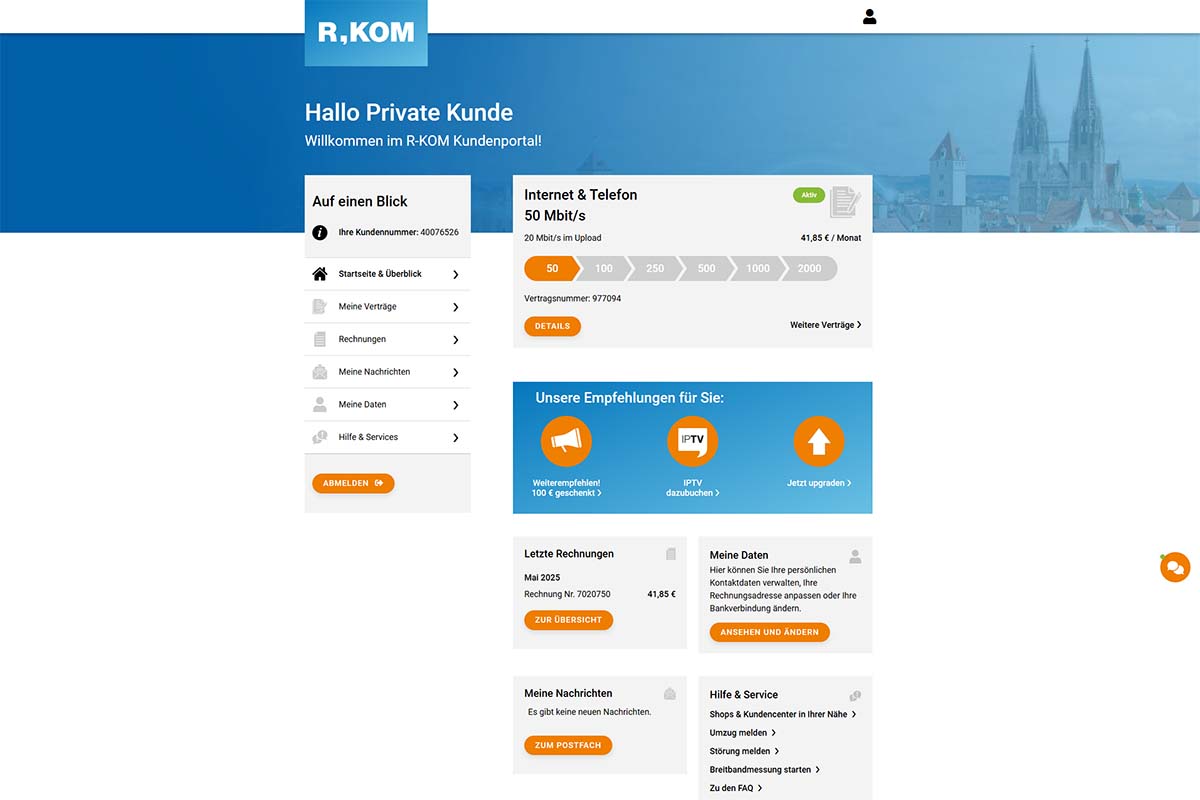
R-KOM now operates a modern, responsive information and booking website, a partner extranet for sales enablement, and a customer self-service portal for profile and contract management – all on one platform.
-
Higher portal engagement. Customer-portal adoption continues to grow (11k registered) as R-KOM has seen an increase in active user numbers (4.5k MAU) even during migration.
-
Unified operations. A single, multi-client instance standardizes technology and governance, reducing operational complexity.
-
Centralized, reusable content. Documents, media, and forms are version-secure, scheduled, and easy to reuse – improving consistency across experiences.
-
Less manual work. Granular roles/permissions and time-controlled publishing replaced ad-hoc substitutions and manual updates, reducing administrative overhead.
-
Better performance and UX. Customers rate the new and responsive website as easier to navigate and faster than the previous stack, reinforcing its role as a sales and service hub.
- Empowered self-service. Customers manage personal data and contracts independently in the customer portal, lowering internal workload.
Conclusion
With Liferay DXP, R-KOM consolidated three portals on one secure, scalable platform, boosting self-service, streamlining content operations, and paving the way for deeper automation. Next up: expanding low-code/no-code use, standardizing content, and using display templates to maintain growing landing pages for new fiber-optic expansion areas.
-
 case studyNo Service like Self-ServiceTelecom provider, O2 Slovakia, used Liferay to build a self-care portal to serve their fast-growing online user base.Read the Case Study
 -
 case study140% More Customers Self-Service with SkyTV's Revamped WebsiteDigital broadcaster and telecom provider SkyTV challenged industry disruptors with a redesigned, scalable website harnessing the power of Liferay PaaS.Read the Case Study
 -
 case studyVodafone Business Moves to the Cloud in Just 6 MonthsVodafone Business needed a customer-first solution that would lead them into the future while keeping costs low.Read the Case Study